
If you have ever wondered why your kitchen can look clean one day and develop a noticeable greasy film shortly afterwards, you are not alone.
Cooking naturally creates grease, even when you are not frying food. Oils and fats can become airborne during cooking, settle on nearby surfaces and gradually form the sticky residue that can be surprisingly difficult to remove.
Understanding why this happens can make cleaning your kitchen much easier. Once you know how grease behaves, it becomes easier to identify the areas that need attention, choose appropriate cleaning methods and prevent heavy build-up.
What Actually Happens To Cooking Grease?
When you cook with oil or fat, heat changes the way it behaves.
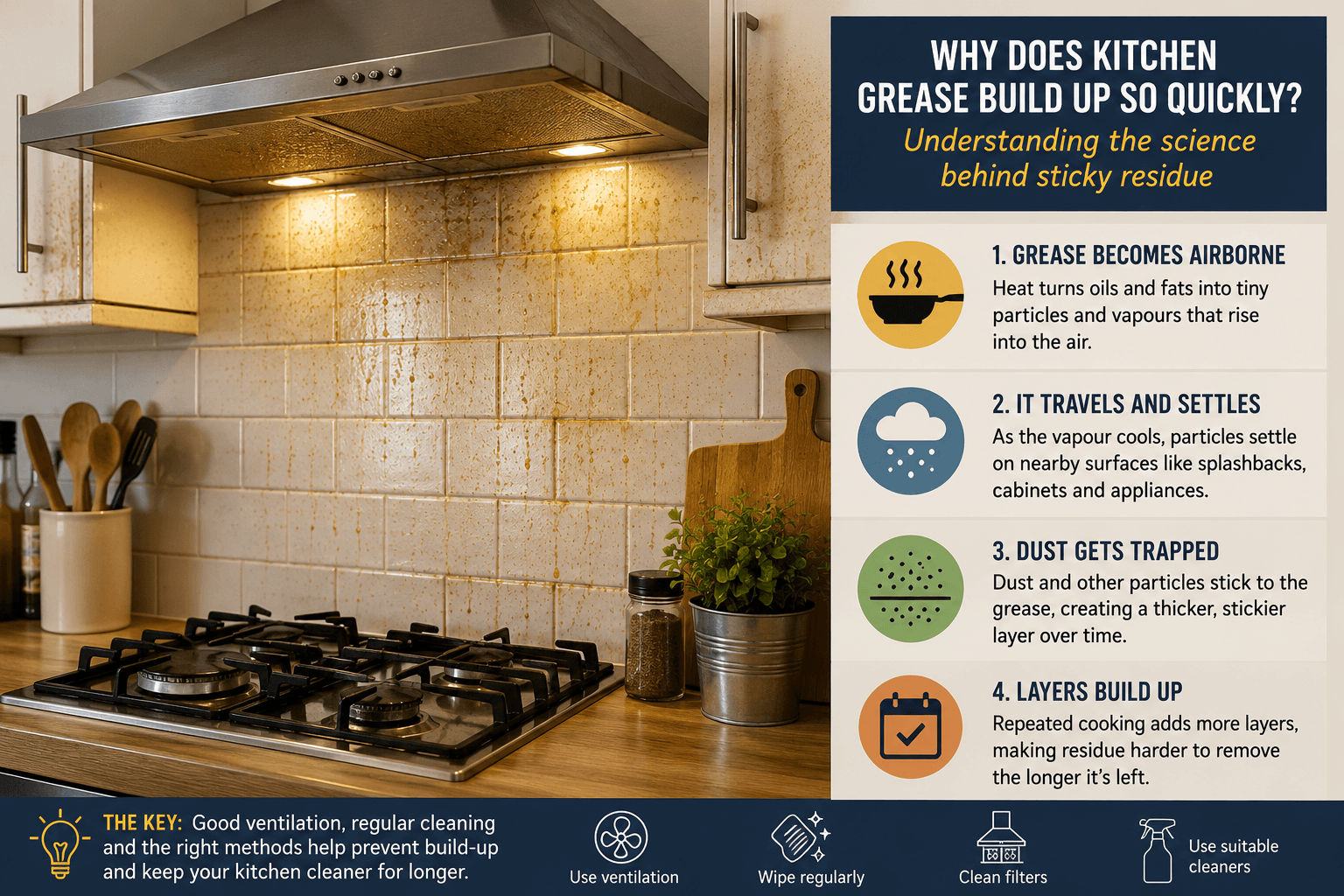
As food heats up, tiny droplets and particles can become suspended in the air. Steam and rising warm air can help carry these particles away from the cooking surface. As the air cools, some of this material can settle on nearby surfaces.
Over time, repeated cooking creates layers of residue. This is why areas around your hob, cooker hood, splashback and nearby cupboards can become greasy even when you cannot see anything settling on them during cooking.
The process is particularly noticeable when cooking at high temperatures or using methods that generate a lot of oil vapour, such as frying.
Why Does Grease Feel So Sticky?
Fresh cooking oil is relatively easy to wipe away, particularly while it is still warm. The problem starts when residue remains on a surface.
Dust and other particles can become trapped in the oily film, creating a thicker and stickier layer. Repeated exposure to cooking vapours can then add further layers. This combination is one reason a surface that has not been cleaned for some time can feel noticeably tacky.
The longer grease is left, the more difficult it can become to remove.
Why Some Areas Get Greasier Than Others
You may notice that certain parts of your kitchen seem to attract grease much faster than others. That is not necessarily a coincidence.
The hob is an obvious hotspot because it is closest to the source of cooking vapours. Cooker hoods and filters can also accumulate significant amounts of grease because they are designed to capture airborne particles.
Splashbacks and nearby walls can receive residue as vapours and tiny droplets move through the air.
Cabinet doors and handles may also become greasy, particularly if they are positioned close to the cooking area. Handles can be especially noticeable because they are touched frequently, transferring oils from hands onto surfaces that may already contain cooking residue.
Ventilation Makes A Difference
Good ventilation can help manage cooking fumes and airborne particles.
Using your extractor fan while cooking can help capture vapours before they spread throughout the kitchen. If your kitchen has windows that can safely be opened, ventilation can also help improve airflow.
However, ventilation systems themselves need attention.
Extractor filters can accumulate grease over time, which can affect their performance. Check the manufacturer’s guidance for cleaning or replacing filters and follow the recommended maintenance schedule.
A clean and properly maintained extractor is more useful than one that is allowed to become heavily coated in residue.
Why Grease Can Be Harder To Remove When It Is Cold
Temperature can affect how easily grease can be removed.
Fresh grease may be relatively fluid, while cooled residue can become thicker and more difficult to wipe away. This is one reason cleaning up soon after cooking can be easier than leaving grease to build up.
However, kitchen surfaces can vary considerably, so always use cleaning products and methods that are suitable for the specific material.
A product that is appropriate for one surface may damage another.
Dust And Grease Are A Difficult Combination
Grease does not always remain a simple oily film.
Once it settles on a surface, it can attract dust and other particles. This can create a darker, heavier layer of grime that is much more noticeable than the original grease. This is particularly common on the tops of cupboards, extractor hoods and other areas that are difficult to reach regularly.
Because these surfaces may not be part of your everyday cleaning routine, residue can accumulate unnoticed for weeks or even months.
Which Kitchen Areas Should You Prioritise?
If you want to stay on top of grease without spending hours deep-cleaning your kitchen, concentrate on the areas closest to the cooking process.
Your priority list could include:
- The hob and surrounding surfaces
- Cooker hood and extractor area
- Splashback
- Nearby cupboard doors
- Handles and switches
- The sides of appliances
- Worktops close to the hob
- Walls immediately surrounding the cooking area
The exact priorities will depend on your kitchen layout and how frequently you cook.
How To Make Grease Easier To Manage
The simplest approach is to avoid allowing layers of residue to develop.
Wiping suitable surfaces regularly can remove grease before it has an opportunity to accumulate. Cleaning spills promptly can also prevent them from becoming harder to tackle later.
It can help to build small cleaning tasks into your normal cooking routine rather than waiting until the entire kitchen needs a deep clean.
For example, once cooking is finished and surfaces have cooled appropriately, you could wipe down the hob and nearby areas. A few minutes of maintenance can be much easier than dealing with a thick layer of accumulated grease later.
Choosing Cleaning Products Carefully
There is no single cleaning product that is ideal for every kitchen surface.
A dedicated kitchen degreaser may be useful for some hard surfaces, while a mild detergent solution may be sufficient for routine cleaning elsewhere.
Always read the product label and follow the manufacturer’s instructions. Never mix different cleaning chemicals, as some combinations can create dangerous fumes.
It is also sensible to test a product on an inconspicuous area when you are unsure how a particular surface will react.
Keeping Grease Under Control
Kitchen grease is an unavoidable part of cooking, but heavy build-up does not have to be.
Understanding how cooking vapours travel, where grease tends to settle and why residue becomes harder to remove over time can help you create a more effective cleaning routine.
Use ventilation where appropriate, pay particular attention to areas around your cooking appliances and clean surfaces regularly rather than waiting for visible build-up.
A little consistency can go a long way. The aim is not to keep your kitchen completely free from grease. Instead, it is to stop everyday cooking residue from becoming a stubborn cleaning problem.